For Shopify stores selling custom stickers and labels

From Shopify Order to Print-Ready File Without a Single Email

The order comes in. Then the real work starts. Email for a better file. Send a proof. Wait. Send another. By the time it reaches the printer you've spent longer in your inbox than on the stickers.

Customers pick size, shape, material and finish, design the sticker on your product page, and approve the proof before they pay. The artwork, proof, print file and cut lines land on the order.

14-day free trial. Free on Shopify Partner dev stores.

★★★★★

"I've accomplished more in three days than I have in years with other sticker configuration applications."

your-sticker-store.myshopify.com

Size of sticker

Shape

Material & finish

Quantity

Total

What to check before you install anything

The First Five Minutes With an App That Wasn’t Built for Stickers

You find out fast. Four things worth checking before you install anything, because a sticker needs all four.

1

The price has to come from size and quantity together

A 2 inch sticker at 500 and a 5 inch at 100 each read their own cell. Most apps only add a set amount per choice, so there is nowhere to put the table.

2

The finish has to be visible on their own artwork

Holographic and glitter carry the markup, and a text dropdown cannot sell either one. Rendered over their own design, the upgrade stops needing a pitch.

3

Quantity breaks, on one axis or two

A run doesn’t drop 10% at 25 and stop. It keeps falling to 2,500. And a big order of small stickers isn’t the same discount as a small order of big ones.

4

The order has to arrive ready to print

The measurements, an approved proof, a print-ready file and the cut line. Without them somebody redraws the outline and emails a proof before anything reaches the printer.

What your sales reports don’t show you

Six Losses That Never Reach a Report

Someone was ready to buy, hit something the page couldn’t do, and left without a word.
Six ways it happens. Under each one, the thing that stops it.

The week you spent in the App Store

Install one. Build a test sticker. Enter a real size and quantity and find out it can’t price it. Uninstall. Most people do that three or four times.

→ Eight questions that rule an app out in two minutes, without installing it

The pricing you simplified to fit the app

Your price list runs on size and quantity together. The app couldn’t, so sizes went into a handful of presets. Every preset overcharges someone or gives margin away.

→ Size and quantity priced together, from the table you already use

The quote form they didn’t fill in

They knew the size, the material and the run. Your page offered a starting-from price and a contact form. Somebody faster gave them a number.

→ Any price calculated instantly, however complex the product

The pages you couldn’t sell from

A quote builder on the home page. A landing page behind an ad that ends in a price, not a contact form. If a calculator only runs on product pages, none of those exist.

→ Put a working calculator on any page, add to cart included

The email thread after the sale

What size did you want? Can you resend the file? Is this the right crop? All questions the product page could have asked.

→ Measurements, an approved proof and a print-ready file on the order

The reorder that never happened

They ordered 500 in March and want the same again in September. If the page can’t remember the size, finish and artwork, they have to rebuild it. They don’t.

→ Reorder puts the whole order back in the cart, options and files attached

None of these show up in analytics, so none of them ever make it onto a list to fix. They just keep happening. Install Appify, build your hardest product first, and you’ll know inside a week which of them were costing you.

Sell stickers other apps can’t price, preview, or produce.

Eight questions that rule out an app in two minutes

Every app lists the same features. Swatches, text fields, uploads, conditional logic.
That list tells you nothing. What separates them is the pricing underneath.

Ask these before you install the next one, Appify included.

  1. Can it calculate a price, or only add prices up? Totalling add-ons is easy. Multiplying an area by a rate, dropping that rate at 500, holding a minimum order and rounding to whole sheets is math, and adding won’t get there.
  2. Can the price come out of a table you paste in? Sticker pricing is a grid: size down one axis, run length across the other. A 2 inch at 500 and a 5 inch at 100 each read their own cell, and no formula smooths between them.
  3. Can one option’s price depend on another? A die-cut line priced by the perimeter, which doesn’t exist until they’ve set a size. A holographic upgrade that costs more per square inch on small runs. Fixed add-on prices can’t say either.
  4. Does a fee stay a fee when the quantity goes up? A $25 setup or die charge on a run of 500 should be $25, not $12,500. Ask directly. You only find out after you’ve built the product.
  5. Can the customer see the finish on their own artwork? Holographic, glitter and mirror carry the markup, and nobody buys them from a word in a dropdown. Rendered over their own design, the upgrade sells itself.
  6. Does the order arrive with a print file and a cut line? Or does somebody open Illustrator, redraw the outline and email a proof back and forth before anything reaches the printer?
  7. Can the customer design the product, and can you limit what they change? Three things get sold under one name. An overlay on your product photo is a personalizer. Crop and filter on an upload is an image editor. A designer is a real artboard, sized by their own measurements, with cut lines and a print-ready file at the end.
  8. Can a customer reorder, and does an abandoned cart come back whole? Shopify’s own Buy again drops every option, so a wrong order lands in the cart looking right. Recovery emails do the same.

Eight yeses is rare. Take the list to whichever app you look at next and get an answer to each one before you commit to it. Or get started with Appify and stop searching.

New: reorder and cart recovery

Buying It Again Shouldn't Mean Building It Again

The size, the shape, the material and the artwork they uploaded were the order. Ask a customer to rebuild all that and your easiest sale turns into work.

Order #228714 March
Custom Stickers
Size3 × 3 in
ShapeCut to Outline
MaterialHolographic
Quantity500
Artworklogo-v3.ai ✓
$484.71 Reorder

It All Comes Back With It

Reorder from the order itself.One tap puts it back in the cart with every option and the uploaded artwork attached, exactly as it was printed the first time.
Or let the customer do it.Past orders sit in the customer portal, so a shop reordering its logo stickers doesn't have to find the old file or remember which finish they picked.
Without it, the cart comes back wrong.Shopify’s own Buy again drops every option, so a wrong order lands in the cart looking right. Recovery emails do the same.
Here it comes back whole.Every option and the right price, restored from the recovery email.

Volume pricing, on the page

Show the Whole Discount Table, Not Just Their Row

Stickers get bought by the hundred, and the next price break is the easiest upsell you have.
It only works if the shopper can see it.

Buy more, save more! You saved 7.5% by ordering 200 units.
Add 200 more to save 10%.
QuantityQuantity discount
10–49
50–99
100–199Save 5%
200–399Save 7.5%
400–499Save 10%
500–749Save 12.5%
750–999Save 15%
1000–1999Save 20%
2000–2999Save 25%
5000+Save 40%

Why this one matters for stickers

It names the next tier in units.“Add 200 more to save 10%” is an upsell nobody has to write, sitting where the decision happens.
The whole table is visible.Someone weighing 200 against 500 can see what the jump is worth without asking you.
Their band is marked.No working out which row applies, and the saving so far is stated rather than implied.

What Merchants Say

One app, many setups

Build the Calculator Your Product Needs

The same app, configured five different ways. Nothing here needs code, and you can run more than one setup across different products in the same store.

Size of sticker

1 x 1 in2 x 2 in 3 x 3 in4 x 4 in 5 x 5 in6 x 6 in

Quantity

50
100
250
500
$115.15
$0.46 per sticker
Starter

Fixed sizes, simple quantities

The setup most shops begin with. A handful of sizes, a few quantity breaks, one clear total. Takes minutes to build and covers a standard sticker catalog.

Quantity discounts

50$30.71
100Save 12%$54.04
250Save 25%$115.15
500Save 38%$190.38
1,000Save 50%$307.06
2,500Save 62%$583.41
$115.15
25% discount applied at checkout
Volume pricing

Tiers that apply themselves

Set the thresholds once, as percent off, dollars off or a target unit price. It applies in the cart and at checkout, with no codes to hand out.

Material

White Vinyl
Holographic
Cracked Ice
Pixie Dust
Clear
Gold Mirror

Finish

GlossyMatteCracked Ice
$161.21
Holographic priced at 1.4x base
Materials

Swatches that carry their own price

Each material can have its own multiplier or its own pricing table, so the premium stock charges what it actually costs you. Customers pick with their eyes instead of guessing from a dropdown label.

Custom dimensions

7.5 in
3.25 in

Any size from 0.5 in to 20 in. Sizes outside your production limits are blocked.

Shape

Cut to OutlineSquareCircle
$642.15
24.38 sq in at 500 pieces
Made to measure

Priced from the real dimensions

The customer types the size they actually need and the price follows the area, not the nearest tier. Validation rules stop anything you cannot produce before the order is placed.

1. Size2. Material 3. Finish4. Artwork

Choose your finish

GlossyMatte MirrorPrismatic

Add ons

Rush production, 2 days
Weatherproof laminate
$160.15
Includes $45.00 rush fee
Multi-step

A long form, broken into short steps

When a product has a lot of choices, walk the customer through a few at a time. Named fees like rush or setup sit on their own line, so nothing looks hidden.

A Real Design Studio, Right on Your Product Page

Bleed guides, safe zones, live cut lines, die-cut smoothness, material previews. Your customer sees exactly what will print before they ever reach checkout.

The Appify Product Designer showing a die-cut sticker with bleed, safe zone and cut line guides, plus shape, border, size and material controls

And None of It Is One Size Fits All

Choose which tools customers see, which effects you offer, how options bind to the canvas and what the approval flow looks like. Turn off anything you don't sell.

Two tools, chosen per product. A personalizer overlays their choices on your product photo. A designer hands them an artboard. Some products want one, some the other, plenty both.

Write your own instructions panel.Built-in designer instructions you control, so customers get your guidance while they design. Explain safe zones, what makes a clean die cut, or how to save. Fewer confused shoppers and fewer support emails.
Set the approval step you want.Require an "I have reviewed and approve my design" confirmation before the design can be saved, or keep it light. Customers can reopen and keep editing right up until checkout.
Show only the tools that fit your product.Text, clipart, uploads, shapes, frames, draw, layers, crop, finetune and filters are each optional. A simple sticker shop and a full print studio can run the same app and look nothing alike.
Bind options to the canvas your way.Decide which selections change the artboard and how, so size, material, pattern and finish drive the preview exactly as your production rules require.

Runs on our Shopify demo store. No install, no signup.
People Buy When They Can See Exactly What They're Getting

A finish listed as a word in a dropdown asks the customer to imagine it. The designer renders the real material over their own artwork, so the upgrade sells itself.

Glossy, matte, mirror, cracked ice, glitter, pixie dust and prismatic are built in, and you can load your own. Effects layer over the artwork, so what they approve is what they receive.

HolographicRainbow shift moves across the artwork as the sticker turns
Glitter and sparkleFlecks catch the light so the finish reads as premium
Clear vinylTransparent background with a cut-edge outline so clear reads correctly

Move the Whole Conversation Before the Order

Every email you send after an order is a question you could have asked before the order.

What size? What material? Is the artwork big enough? Does this proof look right? Where do the cut lines go?

Ask all of it up front, on whichever page they landed on. They configure, watch the price move, upload artwork and approve the proof themselves. The order that lands in Shopify is finished.

That's the difference between an options app and a real sticker workflow. Product options are just the start.

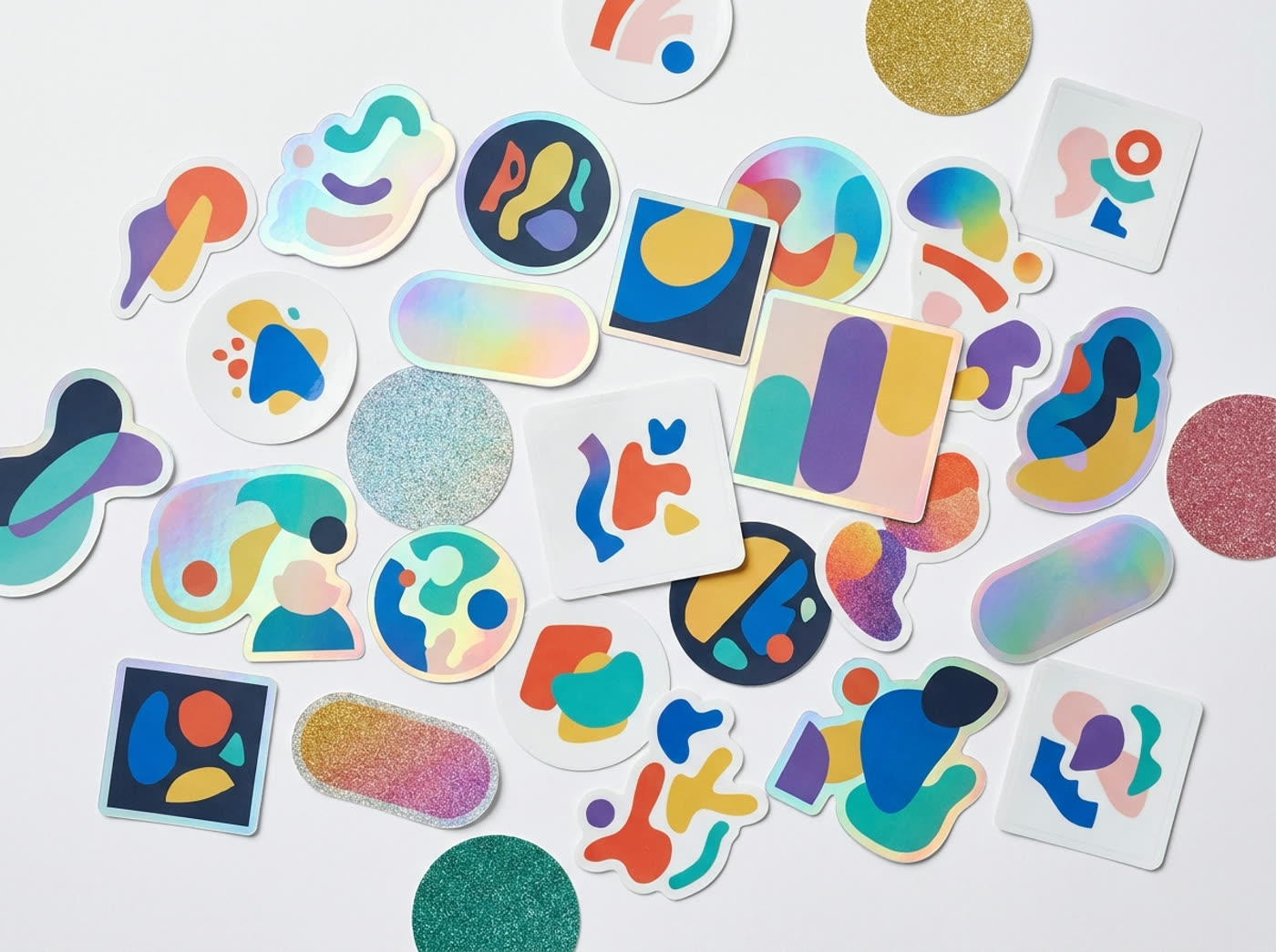
Assorted custom die-cut, holographic and glitter stickers in many shapes and sizes
Try before you install

Want to use it as your customer would?

Our Shopify demo store has fully working sticker calculators set up on it. Configure a sticker, open the designer, watch the price move, exactly as a shopper would. Nothing to install and no signup.

Try the live sticker store

Built for sticker sellers

Everything a Sticker Shop Has to Price, in One Calculator

These aren't generic product options. Each one exists because sticker and label pricing breaks in a specific way, and this is what it takes to fix it.

Die cutKiss cutCircle SquareBumperSheets Roll labelsVinylHolographic ClearGlitterPrismatic

Price It the Way You Actually Quote It

Charge for the exact size, not the nearest tier.Customers type their width and height and the price follows the real dimensions. A 2.75 inch die-cut stops getting billed as a 3 inch, and the small jobs stop quietly losing money.
Discount by size and quantity together.2D quantity discounts let 500 one inch stickers break differently than 500 six inch ones. Flat volume rules over-discount hard jobs and under-discount easy ones.
Volume tiers that apply themselves.Set thresholds as percent off, dollars off, or a target price per unit. Discounts land in the cart and at checkout with no discount codes to hand out.
Keep your rate sheet out of your formulas.1D and 2D pricing tables hold the price grid you already use. Look up by material, size band, or width by height, matching exactly, to the nearest key, or interpolated across a range.
Bill setup, rush and die charges separately.Named fees sit on their own line, can be driven by a formula so they only apply when your rules say so, and hide themselves when they work out to zero.
Add surcharges without a wall of IF statements.Price adjustment rules fire only when conditions match, like oversize, specialty material, or a rush toggle. Stack and reorder them so the logic stays readable.
Write the pricing you actually use.A formula engine covers math, logic, lookups and rounding, and combines product data, customer inputs and variables in one place.
Show how the total was built.An optional price summary breaks the number down line by line, so customers stop emailing to ask why a job costs what it costs.

Options That Fit Every Sticker You Sell

Let them choose with their eyes.Over 15 option types including material swatches, dropdowns with images, multi-select, measurement inputs and quantity fields. Holographic sells better as a swatch than as a word in a list.
Block sizes you cannot produce.Dimension validation marks invalid ranges and shows customers what will actually work, so unbuildable orders get stopped before they are placed instead of after.
Only show what matters right now.Conditional visibility reveals roll options for rolls and sheet options for sheets, and can set minimums, maximums and required fields on the fly.
Break a long form into short steps.Multi-step layouts walk customers through size, then material, then finish, then quantity, instead of one endless form that gets abandoned.
Take the artwork up front.File upload puts the customer's file on the order from the very start, so you are not chasing it after the sale.
Reuse pricing logic instead of rewriting it.Pricing variables split complex pricing into small named blocks you can reuse across totals, fees and adjustments. Change one block when a rate changes.

Fits Your Store, Not the Other Way Around

Native add to cart.It uses your theme's own add to cart button, so there is no cart workaround sitting between your customer and checkout.
No new variants, ever.Options live outside Shopify's variant system, so your product list stays readable and your inventory stays accurate.
Sell from any page.Put calculators on product pages, collection pages or your home page, and run more than one on the same page.
Looks like your store on day one.Six style presets, then every colour, font and corner radius behind them if you want to touch one. Those are variables you can edit, and editing them is optional.
Edit without breaking the live page.Work in draft while shoppers keep seeing the last published version. Save checkpoints before big changes and restore any older version if a change goes wrong.
Sell in up to 10 languages and any Markets currency.Options, help text, buttons and the price summary all translate, with AI filling the gaps, and prices convert through Shopify Markets.

14-day free trial with every feature turned on. From $39/month after.

Every Material, Priced Its Own Way

Holographic costs more than white vinyl. Clear behaves differently than kraft. Set a multiplier or a separate pricing table per material and the price reflects what you actually pay to produce it.

Premium finishes are where the margin lives. When holographic carries its real price instead of a flat add-on, every upgrade a customer picks protects your profit instead of eating it.

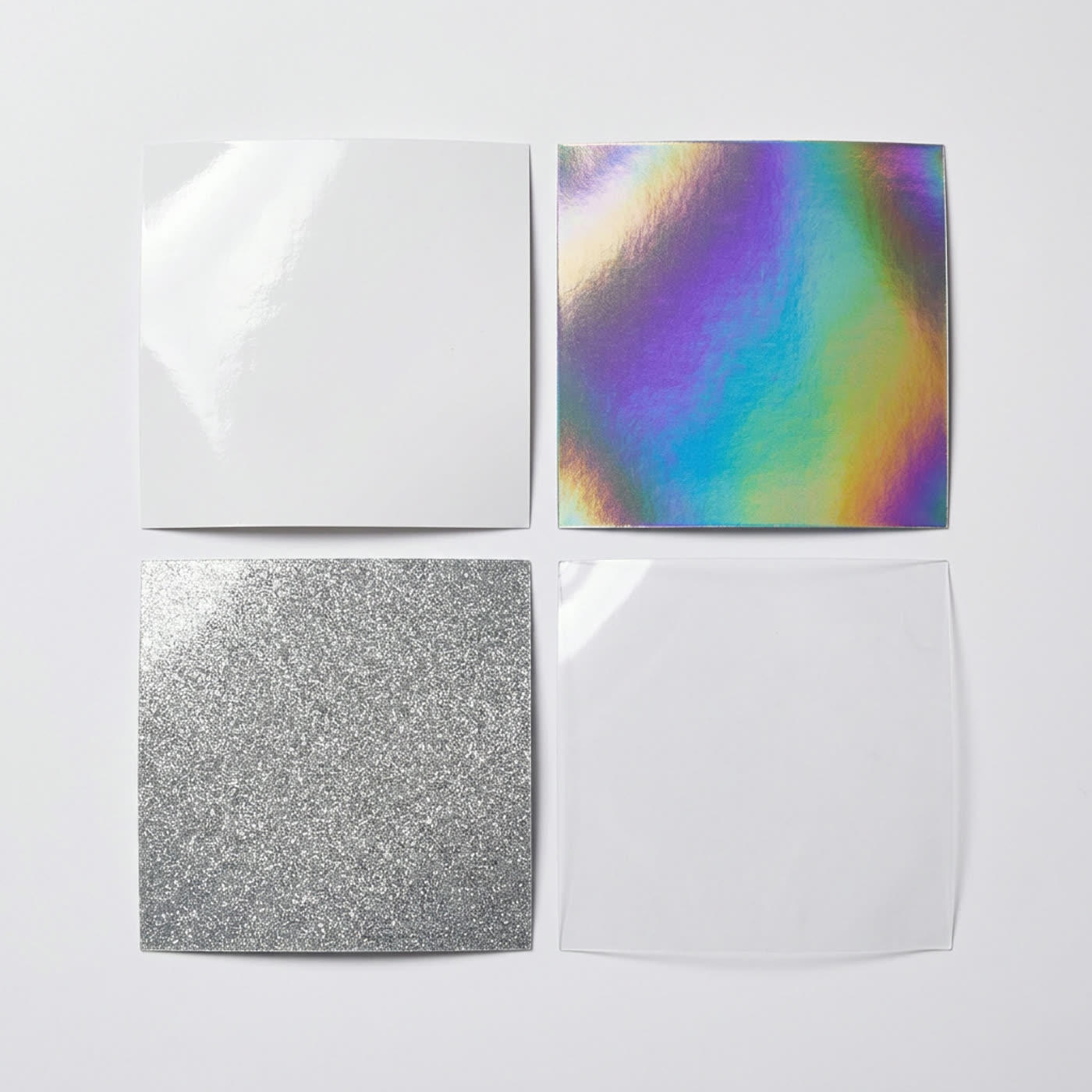
Sticker material swatches: glossy white vinyl, holographic, glitter and clear film

Stop Reprints Before They Happen

Fix bad uploads before they reach you.Crop, filter, enhance, annotate and swap backgrounds on uploaded photos, without a separate app.
Warn on low resolution up front.The designer flags DPI that is too low for the chosen print size, so blurry artwork gets caught before it becomes a reprint.
Get approval before payment.The customer sees the proof and signs off on it as part of checking out. "That is not what I approved" stops being a conversation you have.
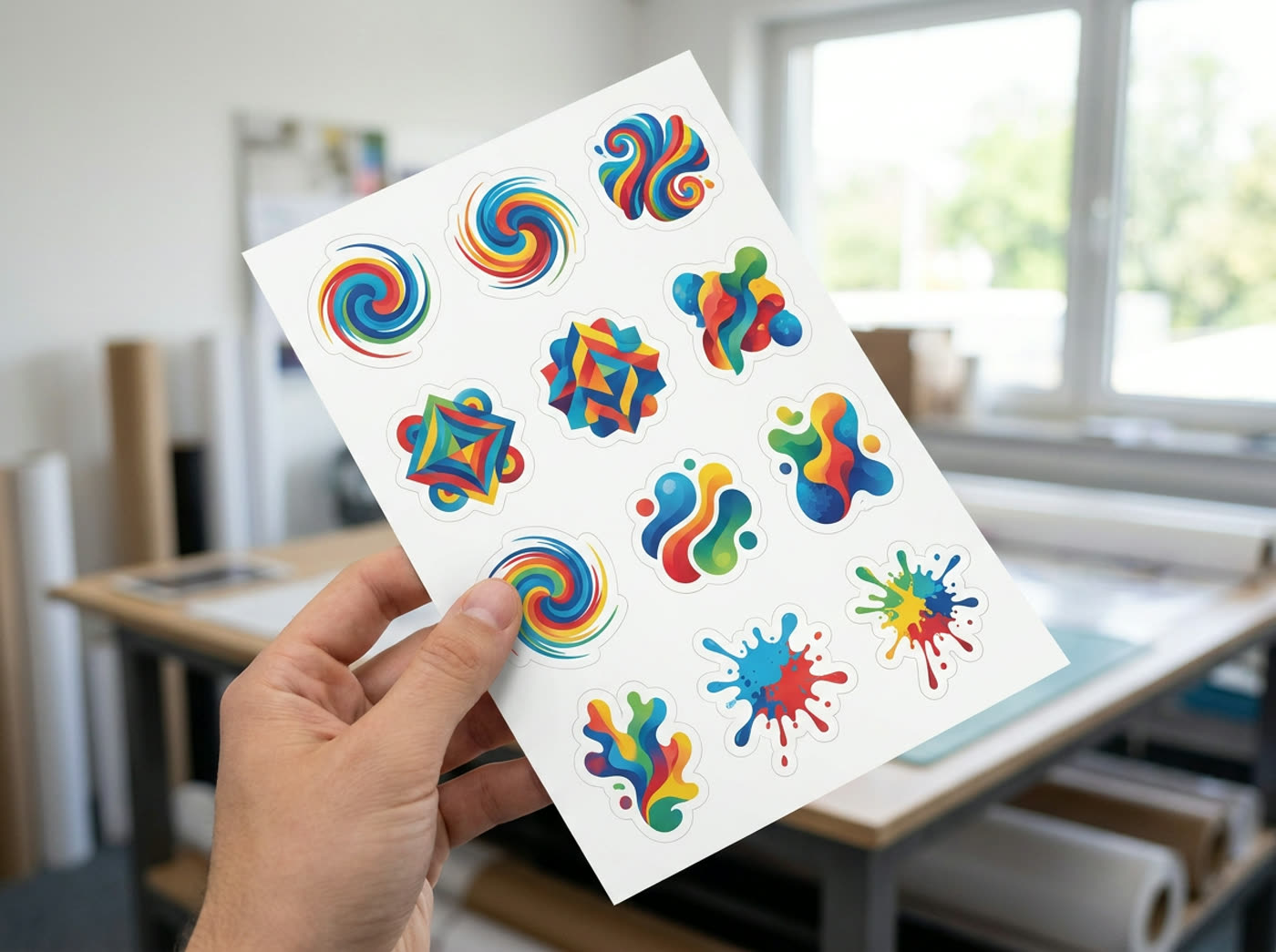
A printed sheet of die-cut stickers with kiss-cut outlines around each sticker

Cut Lines You Didn't Have to Draw

The cut line is generated around the artwork automatically, with border width and smoothness you control. The customer sees the finished shape, and you get the path as an SVG.

Hidden layers stay out of the print file. Mockup overlays never export. What you send to the cutter is what the customer approved.

What Lands on the Order

Not a line item you have to chase. Every configured sticker order carries its full production package.

Original artworkExactly what the customer uploaded or built
Approved proofSigned off before payment, not after
Print-ready filePNG with bleed, ready for the printer
Cut lines and manifestCut-line SVG, canvas JSON, production manifest

Set It Up Without Being Technical

Describe what you want in plain language.AI-assisted setup builds your options, pricing logic and styling from a written description, so you're not writing formulas from scratch.
Get an explanation in plain English.Ask what a piece of pricing logic does and get an answer you can actually read.
Start from a working sticker calculator.The sticker examples on our demo store are real, working setups. Begin from one instead of a blank screen.

Built and Supported from Canada

Support comes from the people who build the app. Ask a hard pricing question and you won’t be explaining your trade to a stranger first.

No first-line queue You’re not passed from someone reading a script to someone who knows the app.
Live chat and email Reach us from inside the app or through the support portal, whichever suits the question.
We know sticker workflows Sizes, materials, cut lines and proofs, not generic app support.

You Might Be Wondering

"I already have an options app that works fine."

For options, most work fine. What happens after the order? If you still email for artwork, build the proof and draw the cut lines, that's the part this replaces.

"This sounds technical. I don't write formulas."

Most merchants here don't. Describe your pricing in plain language and the AI builds it, or start from a sticker calculator on our demo store.

"My pricing is complicated. Will it actually handle it?"

Pricing tables, formulas, variables, conditional rules, fixed fees, minimums and 2D quantity discounts. If you can explain how you price a job, it can be built.

"I don't want customers designing their own stickers."

Then don't turn that on. The designer is optional, and so is every tool inside it. Plenty of shops use the pricing and the file upload without the full editor.

"What if it breaks my theme or slows my page down?"

It uses your theme's native add to cart, so there's no cart workaround to break. You can also work in draft and publish only when you're happy, so shoppers never see a half-finished calculator.

"How do I know it will work for my products before I install?"

Go use it. Our Shopify demo store has real sticker calculators set up on it, so you can configure a sticker and open the designer as a customer would, before you install anything.

What You Get

Everything is included on one plan. There are no feature tiers to climb.

  • Advanced pricing: formulas with logic, math and rounding functions, 1D and 2D pricing tables, variables, rules, fixed fees, minimum prices, 1D and 2D quantity discounts
  • All option types: measurement inputs, swatches, image dropdowns, uploads, text, checkboxes, sliders, date and time, multi-step flows
  • Product Designer: full-screen editor, photo editing, material effects, layers, live canvas bindings
  • Production output: proof PNG, print-ready PNG with bleed, cut-line SVG, canvas JSON, production manifest
  • AI-assisted setup with monthly AI credits included
  • 6 style presets, every colour and font behind them, and draft and publish version control
  • Shopify Markets currency support and translations in up to 10 languages
  • Native add to cart with no variant clutter and no custom code

From $39 / month

Less than most shops charge for a single 100-pack of stickers.

14-day free trial Every feature on every plan Free on Partner dev stores

Install Free on Shopify

Or try it live first if you'd rather see it working before you install.

Try It on Your Hardest Product First

Fourteen days, every feature, no charge. Don't start with your simplest sticker. Take the product you've been pricing by hand, or the one that generates the most email, and build that one.

If it can't handle your hardest product, you'll know inside a week and you won't have paid anything.

Support is included from day one. Ask them to help you build it.

Your Next Sticker Order Could Arrive Finished

Right size. Right material.
Artwork approved by the customer.
Cut lines drawn. Print file attached.

All you have to do is print it.

14-day free trial. Free on Shopify Partner dev stores.

Frequently Asked Questions

Can I see it working before I install?

Yes. Our Shopify demo store has real sticker calculators and the designer switched on, at appify-apps.com/collections/stickers. No signup needed.

Who is this for?

Shopify merchants selling custom stickers, labels, decals and similar printed products. It works for other made-to-order categories too, but this page is about stickers.

Who is it not for?

Stores selling stickers in a few fixed sizes with fixed prices. If Shopify variants already cover your catalog, you don't need this.

Do I have to use the Product Designer?

No. Use the pricing on its own, add a file upload, or turn on the full editor. It's your call, product by product.

Can customers enter any size they want?

Yes, and you can set the limits. Dimension rules block sizes you can't produce before the order is placed.

What files do I get when an order comes in?

The original artwork, an approved proof, a print-ready PNG with bleed, a cut-line SVG, the canvas JSON and a production manifest, all attached to the Shopify order.

Does this create extra variants in my store?

No. Options and pricing live outside the variant system, so your product list stays manageable and stock stays accurate.

Can I give bulk discounts by size as well as quantity?

Yes. 2D quantity discounts let you set different quantity breaks for different size or area ranges, so big configurations don't share the same discounts as small ones.

Do I need to know how to write formulas?

No. Describe your pricing in plain language and the AI setup builds it. You can edit anything it creates.

Can I edit without customers seeing a broken page?

Yes. Work in draft and publish when you're ready. Every publish saves a version, and you can restore an older one at any time.

Does it work in other languages and currencies?

Yes. Up to 10 languages including the designer interface, and Shopify Markets currency conversion.

What does it cost?

From $39 per month, with a 14-day free trial. The subscription scales with how much you use the calculators, and monthly AI credits are included, with an overage charge only if you go past them. Shopify Partner development stores are free.